Guide to the treatment situation
Dental Anxiety from Loss of Control and Sounds: What May Help During Treatment
Treatment sounds, limited visibility and the feeling of being unable to speak can increase tension. Reliable agreements and optional distraction do not make the procedure disappear, but can make it clearer and more predictable.
01
Why loss of control can feel so difficult
In the dental chair, the head is tilted back, instruments are in the mouth and spontaneous speech is temporarily difficult. Someone with previous distressing experiences may feel exposed. The anxiety is then not only about possible pain but also about a lack of predictability.
More orientation is created when the next step, its approximate duration and the pause signal are clarified before starting. Some people want very detailed explanations, while others prefer brief information. Both are valid.
02
A pause signal gives the procedure a clear rule
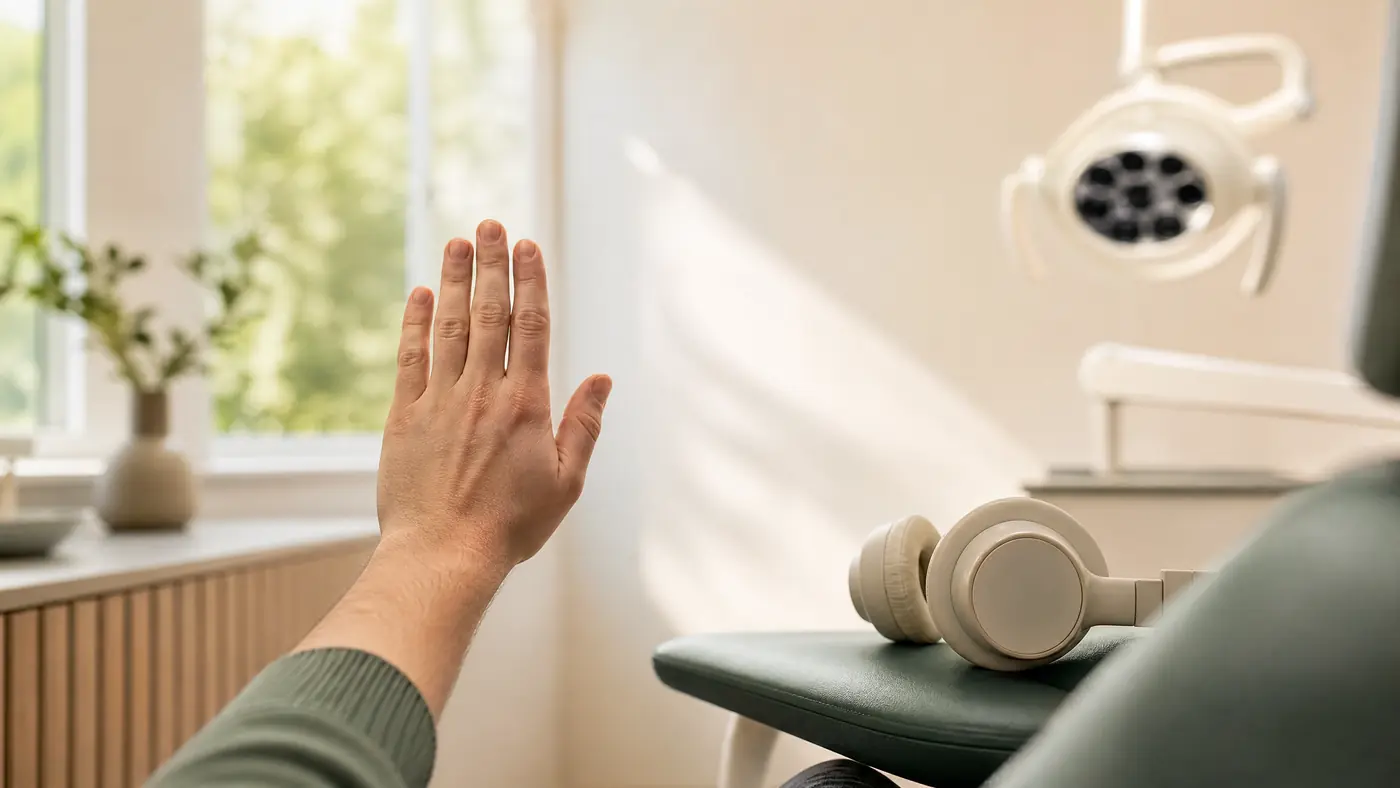
An agreed hand signal is simple, visible and usable even when you cannot speak. It must be clearly agreed before treatment begins. When the patient gives the signal, the current step is paused as soon as it is medically safe to do so.
Once the instruments have been removed, you can clarify what is needed: a moment to breathe, a change of position, another check of local anaesthesia or a clear explanation. This does not provide absolute control over every clinical action, but it creates a reliable form of participation.
03
Announcing sounds and putting them in context
Unfamiliar sounds often feel more threatening than announced ones. A short statement such as “You will hear a loud sound for a few seconds” can help put the sensation in context. The dentist can also explain whether the sound comes from suction, an ultrasonic instrument or another device.
If detailed announcements focus your attention too strongly on treatment, briefer communication may be better. Explain beforehand which type of information reassures you. There is no single communication pattern that suits every anxious patient.
04
Music through headphones as an optional distraction
Familiar music can occupy attention and partly mask practice sounds. Patient information from the German Society for Implantology refers to research suggesting that music may reduce anxiety, stress and pain around medical procedures. Individual effects nevertheless vary.
Headphones are used so that important instructions from the team can still be understood. Volume, type of music and timing should be agreed beforehand. Anyone who prefers to hear exactly what is happening does not have to use headphones.
05
Visual material, gaze direction and clear sensory input
Calm images or video can provide a visual point of focus when the treatment stage and chair position allow. Other people prefer to close their eyes or have an environment with as little stimulation as possible. Personal preference is decisive here as well.
Distraction is not a way to bypass informed consent. Before treatment, you need to understand what is planned, which alternatives exist and which risks are relevant. Music or visual material is only an additional supportive element after that explanation.
Practical checklist
- Confirm the pause signal together before starting
- Agree how much explanation you want
- Have your own headphones and familiar music ready
- Decide whether visual material or closed eyes feel better
- Briefly say what worked after each treatment stage
06
After the appointment: record helpful arrangements
A brief review after treatment can be useful: Which explanation helped? Was the music pleasant? Was the pause signal clear? Which situation remained difficult? This information can be included in planning the next appointment.
For very severe and persistent dental phobia, professional psychological support may also be appropriate. A dental practice can make treatment more anxiety-aware but does not replace individually required psychological assessment or therapy.
Frequently asked questions
Five common questions on this topic
These FAQs supplement the guide but do not replace personal dental advice.
Which hand signal works as a pause signal?
Are instruments removed immediately when I give the pause signal?
Which music is suitable for dental anxiety?
Can I wear headphones during every treatment?
What if music or visuals do not reduce my anxiety enough?
Sources and professional context
Medical note
This article provides general information. It does not replace a personal examination or individual dental or psychological assessment and treatment.
Last clinically reviewed: 05 September 2026
Personal care for anxious patients in Reinickendorf
Read how Mr Spring structures the appointment with you using clear explanations, a pause signal and, if you wish, music or calm visual material.